Fries and religion: a paper cone at heaven’s gate
Posted on : 19-05-2026
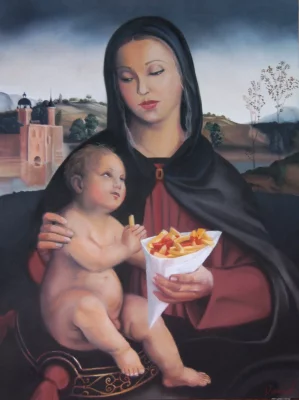
In Belgium, fries are not just food: they are a ritual, a shared language, a small, crunchy absolute. As for religion, it has left in the landscape a constellation of places, gestures, calendars and imaginaries with which the fritkot has gradually developed strange affinities.
At the heart of Home Frit’ Home’s Micro Fries Museum Brussels, discover in summer 2026 the exhibition “Fries and Religion”!
- Archival documents, contemporary artworks, photographs, objects of more‑or‑less avowed devotion… and, right in the centre, the friturist as a quasi‑priestly figure!
- Saturdays 6 June, 4 July, 1 August (1.30 pm–6.30 pm) and Sundays 7 June, 5 July, 2 August (1.30 pm–6.00 pm). Rue des Alliés 242, 1190 Brussels - Forest.
- Facebook event: https://www.facebook.com/events/1277287334583274/
At first sight, religion and fries seem to belong to opposite worlds: on one side elevation, silence, liturgy; on the other the queue, the smell of fat, the paper napkin stained with sauce. And yet, in Belgium, these two universes have constantly intersected, at times to the point of sharing the same squares, the same crowds and even the same church forecourts. Village fairs, descended from the kerkmis – literally the “church mass” celebrating the consecration of the building – have long combined religious feast, popular funfair and street food, offering fries an ideal ground on which to spread.
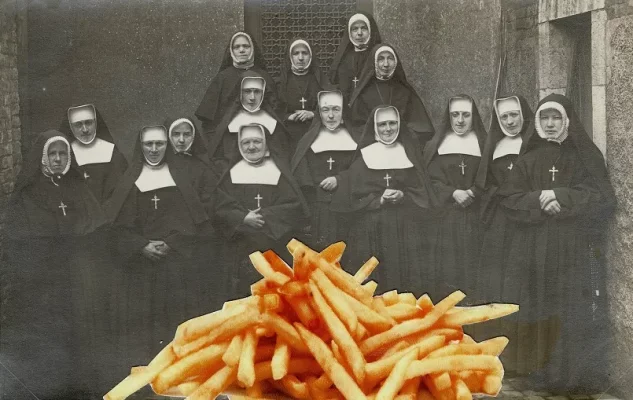
A very earthly faith
The potato did not enter Europe through the grand gate of gastronomy. Long regarded with suspicion, sometimes deemed dubious simply because it grows underground, it first circulated in medical, hospital and monastic contexts before conquering everyday use. It did not take much for the Belgian imagination (and Paul Ilegems in particular) to give it almost mystical origins, turning Teresa of Ávila into a kind of apocryphal patron saint of fries in the middle of the sixteenth century. This sliding between history, belief and fantasy is, in many ways, deeply Belgian. Here, documentary truth coexists quite happily with a well‑fried legend. People argue in all seriousness about double‑frying, about beef fat or not, or about the true origin of the golden stick of potato, with a gravity that at times recalls the best‑seasoned theological disputes.
The fritkot as a local chapel
After these detours through origins and beliefs, one place remains to be observed: where the whole story becomes tangible, in the fritkot itself. A chip stall is not just a sales counter. It is a place of loyalty, memory, return and consolation, with its regulars, its tacit opening hours, its approach rituals and its tutelary figures. In many Belgian towns, fritkots have set up next to churches, town halls, railway stations or monuments, as if they had instinctively chosen the nerve centres of collective life. The friturist plays a key role there. He or she is not only the one who serves, but also the one who keeps watch, recognises customers, listens between the lines and maintains a sense of continuity in a changing world. It becomes easy, then, to see a portion of fries less as a mere snack than as a small public gesture of reassurance.
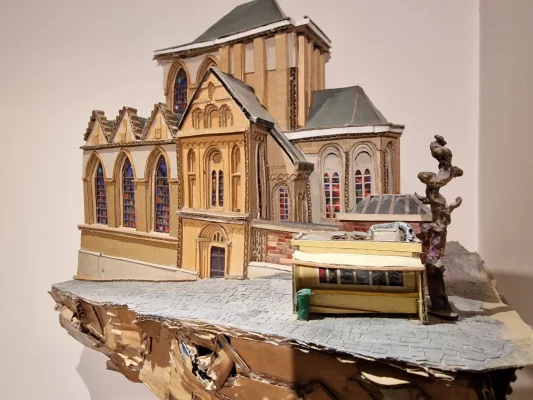
Rituals, fries, queues and shared beliefs
A religion is often recognised by its rituals, its objects and its temporary communities. Seen from this angle, the officially recognised Belgian fritkot culture as intangible heritage does not lag behind: there is the queue, the order recited almost without thinking, the waiting in front of the fryer, the reflex to grab the first fry while it is still too hot, the sauce chosen as one chooses a side. There are also doctrinal quarrels, orthodoxies of taste, frozen heresies and childhood memories elevated to the status of revealed truth.
A civil religion, Belgian‑style
The strength of fries may well lie in their ability to connect what everything else tends to separate. They move effortlessly across social classes, regions, languages and convictions – something many institutions could only dream of. Where grand national narratives sometimes struggle to persuade, the fritkot keeps bringing people together, without speeches, simply through warmth, smell and shared habit. In that sense, fries and religion have at least one thing in common: both speak of community, transmission and belief. With one very Belgian nuance: in one case, salvation remains invisible; in the other, it arrives in a paper cone, burns your fingers ever so slightly and is eaten standing up.
To dig deeper into fries
- Hugues Henry & Albert Verdeyen, «Carrément frites» (Renaissance du Livre, 2012).
- Paul Ilegems, «Toute la frite belge / Het Belgisch Frietenboek» (Loempia, 1994).
- Pierre Leclercq, «Histoire de la pomme de terre frite. De l’émergence d’une technique culinaire au triomphe d’une culture» (Éditions du Petit Lancelot, 2026).
- “Culture fritkot belge” dossier (Belgian intangible cultural heritage).
Add a comment